In October 2022, the British Charitable Foundation celebrated 75 years of dedicated work on behalf of older people. In this article, we spoke to members of the community, staff and friends to discuss moments Key milestones in the institution’s history, our mission and challenges. Take a look!
Stacey House: where it all began
The history of the British Charitable Foundation began even before its formal establishment in 1947 and is intertwined with the history of the British Society of São Paulo. In 1940, British citizens residing in the state of São Paulo elected a Community Council, which was later renamed the British Society São Paulo, to promote the interests of veterans of the British Armed Forces who had served during the Second World War. After the end of the conflict in 1945, the community decided to remain active in order to continue its activities and social services in the state capital, São Paulo.
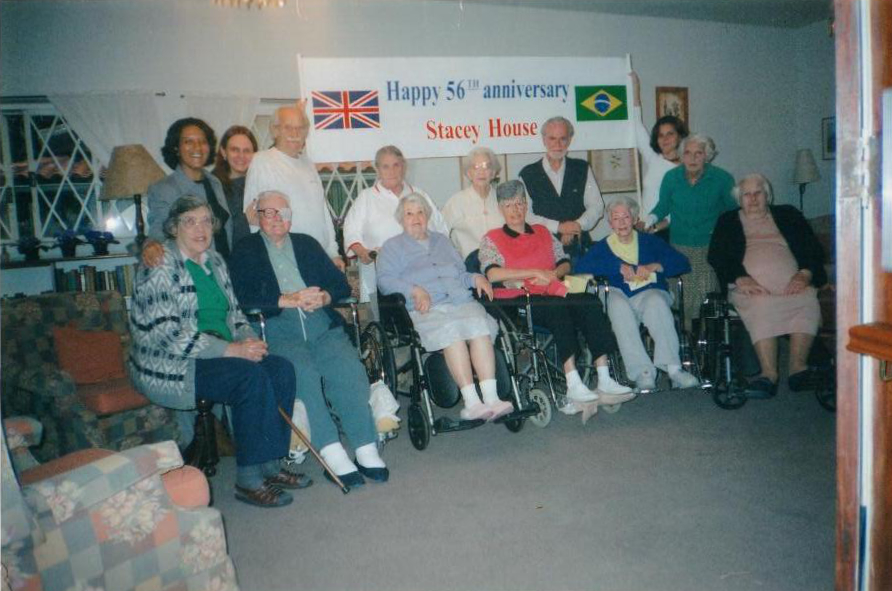
Two years later, in 1947, Helen Stacey, a deeply committed British citizen, opened the doors of her home in Jardim Prudência, in the South Zone of São Paulo, to provide assistance to her compatriots in vulnerable circumstances, most of whom were elderly. And so the ‘
’ was born Stacey House , a place which, as well as being a cosy home for the elderly, has come to be a space where the entire British community in São Paulo can come together and strengthen their bonds.
Rachel Govier, the Foundation’s vice-chair, says she began visiting the home when she was still a child. “I had relatives who lived there. My mum used to take me along to chat with the elderly residents, and when my children were born, I’d take them along because their great-grandmothers lived there. It was lovely. I’ve always enjoyed talking to the elderly and listening to their stories,” recalls Rachel.
Sandra Pavani, who has been the Foundation’s financial supervisor for 22 years, also fondly recalls the years she spent at Stacey House. “That house had a fireplace and a sofa that were very inviting for a chat. The elderly residents who lived there were fantastic,” recalls Sandra. “It was like a hall of residence for older people. Friends would sit together to chat, play cards – there was a really lovely atmosphere.”
At the Foundation’s headquarters, a box contains dozens of photo albums documenting events held at the centre since it first opened. These include Sunday lunches, birthdays, and celebrations for Easter, Christmas, New Year and Carnival. These records capture the great warmth and affection shared between the elderly residents, their families, the staff and members of the community.
As well as visiting relatives and taking part in some of the festivities, physiotherapist Penny Ahlgrimm made a significant volunteering with the elderly by running weekly exercise classes and sessions for 28 years. “It was such a pleasure to do this work, and I think they felt that too – they’d always ask me when the next class would be,” recalls Penny. The physiotherapist’s generosity and dedication were recognised not only by the community, but also by Queen Elizabeth II. In 2020, she was awarded the MBE (Member of the Most Excellent Order of the British Empire), an honour bestowed upon individuals who have made outstanding contributions to the British people.
Lunch with the community
Move to ILPIs (Long-term Care Homes for the Elderly)
The property where Stacey used to operate House provided a cosy home for around 130 elderly people from the local community for nearly 60 years and was the starting point for the establishment of the British Charitable Foundation. However, as time went on, the residents’ advancing age meant they required increasingly more care, and the home’s facilities were no longer sufficient to look after them properly and in a financially sustainable manner.
Consequently, in 2006, the FBB’s board decided to close Stacey House and transfer the elderly residents to long-term care homes, which already have staff and infrastructure in place suitable for providing 24-hour care for its residents. This marked the start of Programme Acolher
.
Derek Barnes, a trustee of the Foundation, remembers this transition process well. “
president of the “At the time, I was asked to carry out an economic feasibility study on Stacey House, and we found that keeping it as it was was not viable,” recalls Derek. “The move was the best solution we could find.”
A group of elderly women in the garden at Stacey House
Craft workshop at the CCI in Paraisópolis
Expansion of the projects
The transition from Stacey House to ILPIs marked a shift in the institution’s focus and culminated in initiatives that redefined its guiding principles. The British community realised that the Foundation’s work could be expanded and that the time had come to give something back to Brazilian society for the welcome and care their ancestors had received in Brazil. With this in mind, other programmes and projects were set up dedicated to the cause of older people in general, regardless of their background.
Multiplicar Programme has been providing support to reputable organisations that take in and care for elderly people in situations of severe vulnerability since 2009. The Foundation contributes financial and human resources to the Casa Madre Teodora dos Idosos and Lar Benção care homes. In October 2018, the ‘’ Senior Citizens’ Community Centre (CCI) was established, a project offering a weekly programme of free activities that promote healthy ageing, such as memory workshops, music lessons, theatre, yoga and circle dancing, amongst others. The sessions began as in-person events at Cultura Inglesa’s headquarters in Butantã and moved online due to the pandemic. The project currently has 100 older people enrolled who, in addition to what they have learnt in the workshops, have strengthened friendships and bonds through their regular participation in the activities. And, since August this year, the CCI has also been offering weekly activities at the Cultura Inglesa headquarters. An Englishwoman from Paraisópolis.
Work with the British community has also been expanded with the creation of the ‘Cuidar’ and ‘Amparar’ programmes. The
‘Cuidar’ Programme It accompanies elderly people to medical appointments and clinical examinations, carrying out preventive work and providing support to those who need help with their healthcare. “We provide a hospital companion to help families when a relative is in hospital. “We help older people book appointments, remind them of their appointments, accompany them to their appointments and report back to their families on what the doctors have told us,” explains Rachel. “We also do our utmost to ensure older people can remain in their own homes, even if this means with the help of carers.” Amparar Programme
provides support to the most vulnerable elderly people to meet their basic needs for food, housing, healthcare and medicines.
All these changes demonstrate just how much the FBB’s work has evolved, grown and adapted over the past 75 years. But there is one thing that has never changed: the care and respect shown to older people. And in this year, which is so significant in the institution’s history, the entire team and management have been meeting to rethink its mission, its projects and its funding models. Because we know we can do much more and we face new challenges, such as finding new premises in Butantã to resume the CCI’s face-to-face activities in the region and securing funding to expand the services on offer. ““My dream is to have a large centre that operates daily and provides services such as dental care and the fitting of hearing aids, amongst others. I also hope that we can offer more activities to elderly Brazilians,” adds the Vice-President. May the strength of our commitment to those who have already done so much for us help us to go even further in the years to come.
Visit to a care home for vulnerable elderly people
Memorable stories
Those interviewed for this article shared some memorable and intriguing stories that have witnessed over the course of these 75 years of FBB. See some of them below.
There was a resident at Stacey House who one day said she wanted to take drum lessons, and I asked, “Have you always wanted to take drum lessons but never had the chance?” And she replied, “No, it’s just that in the afternoons these old folks are asleep and it gets very quiet here, so by playing the drums I’d liven this place up a bit.”
– Sandra Pavani
We celebrated the 100th birthday of one of our residents, Mrs Gertrude Vigar, and I was deeply moved to see her reaction as she entered the building housing the FBB office and saw all her relatives and friends. Seeing her face beaming with happiness as she experienced that moment was absolutely lovely! And when Prince Harry came to Brazil, she was persuaded to speak to him at an event. The protocol allowed for five minutes, but he loved it and they chatted for over 20 minutes. She was very proud to tell this story.
– Sandra Pavani
The first time I taught a class for the elderly at Stacey House, I started with some seated exercises and then asked everyone to stand up to carry on with the movements. And two elderly ladies fell to the floor because they lost their balance. It was such a fright! I thought I’d never teach them again. However, nobody was hurt; I adapted the class to consist solely of seated movements and everything went well.
– Penny Ahlgrimm
When I used to organise the Queen’s Birthday Party , used to get large donations of British cheeses to serve to the guests. And there was a lady who, as well as eating, would, when no one was looking, stuff lots of cheese into a bag and take them home. It was very funny – she just loved British cheese!
We use necessary cookies for the website to work and, with your consent, analytics and marketing cookies. You can accept, reject or customise your choices. Privacy Policy
Preference centre
Choose how your data may be used
Necessary
These enable security and essential functions. They cannot be disabled.